Image provided by: Taito City Office, Tourism Division
Every November, Japan comes alive with the vibrant energy of Tori no Ichi, a traditional festival where people wish for luck and booming business in the year ahead. Especially lively in the Kanto region, iconic spots like Asakusa’s Otori Shrine and Shinjuku’s Hanazono Shrine draw huge crowds - including curious international visitors. In this article, we’ll explore the rich history behind Tori no Ichi, spotlight the top places to celebrate, and reveal the must-see sights. Get ready to experience one of Japan’s most spirited and fortune-filled festivals firsthand.
Culture
Oct 31. 2025
[2025] Let's Go to Tokyo's Night Market! A Complete Guide to "Tori no Ichi," Japan's Winter Festival for Good Business and Fortune
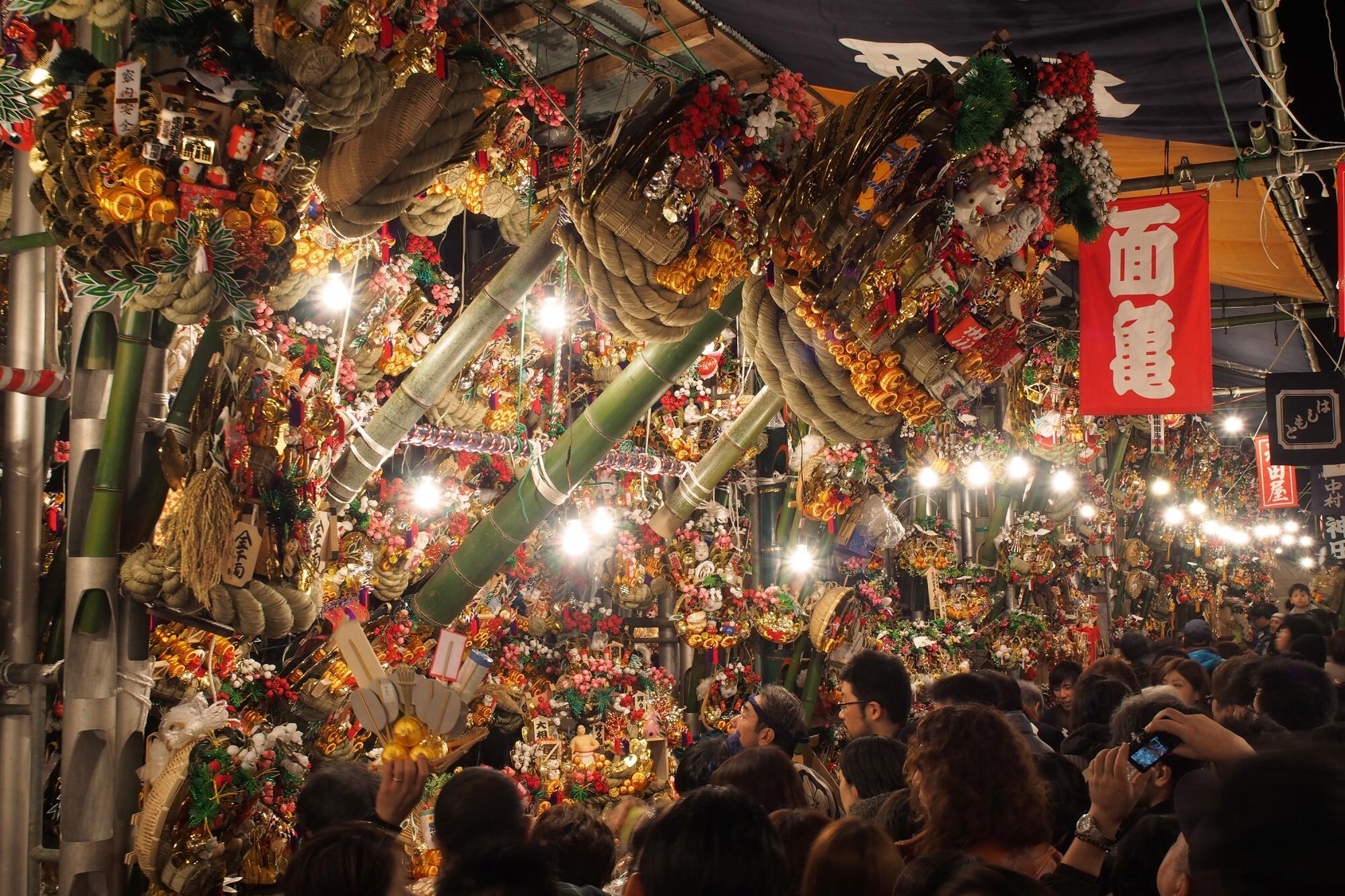
What is Tori no Ichi? History, Timing, and Main Locations

Image provided by: Taito City Office, Tourism Division
As autumn fades into winter, Japan comes alive with the festive spirit of Tori no Ichi - a time-honored celebration held every November. With roots tracing back to the Edo period, this vibrant event is all about praying for good luck and thriving business in the year ahead. But what exactly is Tori no Ichi, and why does it continue to draw such excitement year after year? Let’s take a closer look.
When: Held every "Tori Day" in November
Tori no Ichi is held on "Tori Day" in November each year.
“Tori Day” is based on the traditional Japanese zodiac calendar, which cycles through twelve animal signs - like Rat, Ox, and Tiger - every twelve days. Because of this, Tori no Ichi isn’t just a one-day event! In November, the festival is held two or sometimes even three times, depending on the year. These are known as Ichi no Tori (first Tori), Ni no Tori (second Tori), and occasionally San no Tori (third Tori).
Where: Otori Shrines and "Tori Temples" around Japan
Tori no Ichi is held at Otori Shrines (also known as Ohtori Shrines), particularly concentrated in the Kanto region including Tokyo. Here are some of the main shrines and temples:
- Otori Shrine and Chokokuji Temple (Asakusa, Tokyo)
- Hanazono Shrine (Shinjuku, Tokyo)
- Okunitama Shrine (Fuchu, Tokyo)
- Hanahata Otori Shrine (Adachi, Tokyo)
- Kotohira Otori Shrine (Yokohama, Kanagawa Prefecture)
Historical Background: A Festival for the People, Born in the Edo Period
The roots of Tori no Ichi stretch back to the Edo period, with its origins believed to lie in the festival at Hanahata Otori Shrine in Adachi, Tokyo. From there, the tradition quickly spread across Edo (modern-day Tokyo), with the Asakusa celebration gaining particular fame thanks to its large crowds of devoted worshippers.
Originally held as a way to give thanks for the autumn harvest, Tori no Ichi gradually evolved into a bustling event where people pray for good fortune and booming business. One of the most iconic sights of the festival is the rows of vendors selling kumade - ornate “rakes” decorated with lucky charms and talismans - lining the shrine grounds and spilling out onto the lively streets beyond.
Top Tori no Ichi Destinations
Hanazono Shrine in Shinjuku [Shinjuku, Tokyo]
Located in the heart of Shinjuku, Hanazono Shrine is a centuries-old sanctuary that has quietly witnessed the evolution of Tokyo. Its exact origins are unclear, but it is said to have existed even before Tokugawa Ieyasu established the Edo Shogunate in 1603.
Tori no Ichi at Hanazono Shrine took shape during the Meiji period, celebrated on each "Tori Day" in November to honor the deity Yamato Takeru no Mikoto - the date marking the anniversary of his death.
During the festival, the shrine transforms into a vibrant maze of glowing lanterns and bustling stalls, where merchants sell colorful kumade (decorative rakes) believed to “rake in” good fortune. Adding to the excitement, Hanazono is also known for its lively traditional sideshows.
2025 Scheduled Dates:
- Ichi no Tori Eve Festival: November 11 (Tue)
- Ichi no Tori Main Festival: November 12 (Wed)
- Ni no Tori Eve Festival: November 23 (Sun)
- Ni no Tori Main Festival: November 24 (Mon, public holiday)
- Address: 5-17-3 Shinjuku, Shinjuku-ku, Tokyo
- Access: 3 min walk from Shinjuku-sanchome Station, 7 min walk from Shinjuku Station
- Official Website: http://hanazono-jinja.or.jp/
Otori Shrine in Asakusa [Taito, Tokyo]
Image provided by: Taito City Office, Tourism Division
Though the exact founding date of Hanahata Otori Shrine remains a mystery, it is home to one of Japan’s oldest Tori no Ichi festivals - an unbroken tradition dating back to the Edo period. The celebration kicks off at the stroke of midnight on Tori Day with the dramatic sounding of the “First Drum”, marking the start of a full day of vibrant festivities.
During the Edo period, the shrine was managed by the neighboring Chokokuji Temple, and to this day, the festival takes place at both locations. Its scale is among the largest in Japan, with around 150 kumade stalls and 750 food and game stalls. It attracts more than 700,000 to 800,000 worshippers every year.
2025 Scheduled Dates:
- Ichi no Tori: November 12 (Wed) 0:00–24:00
- Ni no Tori: November 24 (Mon, substitute holiday) 0:00–24:00
- Address: 3-18-7 Senzoku, Taito-ku, Tokyo
- Access: 7 min walk from Iriya Station, 8 min walk from Minowa Station, 8 min walk from TX Asakusa Station
- Official Website: https://otorisama.or.jp/
Kotohira Otori Shrine [Yokohama, Kanagawa Prefecture]
Kotohira Otori Shrine in Yokohama, Kanagawa is also famous as one of the leading Tori no Ichi festivals in the Kanto region.
It is said that the shrine was established in Ansei 6 (1859), when Yokohama opened its port, to pray for prosperity in business under the protection of its guardian deity. The Tori no Ichi here has since been designated as an Intangible Folk Cultural Asset of Yokohama City. One of the most enchanting sights is the glowing rows of lanterns that illuminate the shrine grounds, casting a warm, festive glow. The surrounding streets and Odori Park come alive with colorful kumade stalls, mouthwatering street food, and the joyful energy of the crowd. Just a short stroll away, Yokohamabashi Shopping Street also buzzes with visitors.
2025 Scheduled Dates:
- Ichi no Tori: November 12 (Wed) 11:00–21:30
- Ni no Tori: November 24 (Mon, public holiday) 11:00–21:30
- Address: 1-3 Maganecho, Minami-ku, Yokohama, Kanagawa
- Access: 2 min walk from Bandobashi Station, 8 min walk from Koganecho Station
- Official Website: https://yokohama-torinoichi.jimdofree.com/
Highlights of Tori no Ichi: Kumade, Tejime, Food Stalls, and More
The biggest appeal of Tori no Ichi lies in its vibrant atmosphere and the chance to experience unique aspects of Japanese culture.
The Charm of Kumade and How to Choose One: Meaning, Designs, How to Buy and Bargain, and Tejime
Image provided by: Taito City Office, Tourism Division
Image provided by: Taito City Office, Tourism Division
When it comes to Tori no Ichi, the must-have lucky charm is the "kumade." Originally just a farming tool used to gather fallen leaves, it eventually came to be seen as a tool for "raking in happiness and wealth." At Tori no Ichi, you’ll find all kinds of decorative kumade for sale, decorated with lucky symbols like the smiling Okame mask, large gold coins, treasure ships, or even the zodiac animals.
There’s a saying that the cheaper you manage to buy a kumade, the more luck it brings, so bargaining between sellers and buyers is part of the tradition. Once the deal is made, both the seller and the buyer perform "tejime," a rhythmic clapping ceremony.
The style of tejime differs by region, but in Kanto, it usually starts with a call of "Iyo!" followed by either "Sanbon-jime" or "Ippon-jime." Sanbon-jime goes "Ta-ta-tan, ta-ta-tan, ta-ta-tan-tan," while Ippon-jime is just a single sharp clap. As you walk around, you’ll hear these calls and claps echoing everywhere, adding to the lively atmosphere of the festival.
Tradition also says that you should carry your kumade home held high, as if scooping up good fortune, and then display it in a high place like above the entrance or under the ceiling of your home to keep away bad luck.
Lucky Foods You Can Try at Tori no Ichi
Kiri-zansho
Among the many foods sold at the stalls, the most famous is "kiri-zansho." It’s a soft, slightly sweet rice cake with a spicy kick of Japanese pepper. People have eaten it for centuries as both protection from evil and a way to bring in good fortune.
Atama no Imo (Head Potato)
Another food you’ll see is a type of taro called "yatsugashira," also known as "atama no imo" or "head potato." Because many shoots sprout from a single root, it’s seen as a symbol of fertility and is considered a lucky food.
Tips for Enjoying Tori no Ichi
Image provided by: Taito City Office, Tourism Division
What’s the difference between the First Tori, Second Tori, and the Eve Festival vs. the Main Festival?
The First Tori, Second Tori (and sometimes even a Third Tori, depending on the year) simply mark the order of "Tori Days" in November. There’s no real difference, so you can visit on any of them.
That said, there’s an old belief that in years with a Third Tori, fires are more likely to break out, so people are especially reminded to be careful with fire. The most recent year with three Tori Days was 2024.
Some shrines and temples also hold an Eve Festival, but this is really just considered part of the main festival, so don’t expect anything special or different. Since opening hours vary by location, make sure to check the official information of the Tori no Ichi you plan to visit before heading out.
How to Handle the Crowds
Tori no Ichi draws huge crowds - especially in the evening hours. For a more relaxed experience, head over in the morning before the rush begins.
That said, one of the festival’s charms is the magical night atmosphere, when the lanterns are lit and the grounds look like an exotic night market. If you plan to go at night, just be prepared for heavy crowds. Weekdays are usually less packed than weekends and holidays.
What to Wear and Bring
Nights in Japan in November can get pretty chilly, so make sure to dress warmly. Since you’ll be walking a lot, wear comfortable shoes. Also, most stalls only accept cash, so having Japanese yen coins on hand will make shopping easier.
Photography Etiquette
It’s natural to want to capture the atmosphere in photos, but please be mindful not to disturb other visitors or stall owners. Especially when photographing people, remember to ask for their permission first - good manners go a long way.
What’s the Difference Between Tori no Ichi and "Ebisu-ko"?
Just like Tori no Ichi, "Ebisu-ko" is also a festival known for praying for success in business. Both are held in autumn and dedicated to gods of prosperity, but their origins and unique features are different.
Comparing Blessings, Origins, and Timing
| Tori no Ichi (Tori Festival) | Ebisu-ko | |
| Gods Worshiped | The deities of Otori Shrine and related temples | Ebisu, one of the Seven Lucky Gods |
| Main Blessings | Prosperity in business, good fortune, safety at home, abundant harvests | Prosperity in business, bountiful catches and harvests |
| Origin | Began as an agricultural harvest festival and a celebration for good fortune | A festival celebrating the day Ebisu, one of the Seven Lucky Gods, returns after meeting with local deities |
| Main event period | Every November on the "Day of the Rooster" in the lunar calendar | October, November, or January depending on the region |
| Main Lucky Charms | Kumade rakes, used to "rake in" good fortune | Items such as sea bream and "daifuku-cho" ledgers symbolizing wealth |
While Tori no Ichi focuses on praying for prosperity and good fortune through decorative kumade charms, Ebisu-ko centers on worshiping Ebisu to wish for success in business and thriving fisheries.
Both are lively, traditional Japanese festivals, but each has its own unique history and meaning.
Experience Japanese Traditions at Tori no Ichi
Tori no Ichi is more than just a festival - it’s a rare chance to experience Japanese traditional culture firsthand. You’ll feel the spiritual connection of prayers to the gods, the vibrant energy of the community, and the way traditions are still carried on today. If you have the chance, definitely go and experience it for yourself.
References:
・Tanaka Shonichi and Noboru Miyata, eds., Sanseido Annual Events Encyclopedia Revised Edition, first edition, Sanseido, 2012, 458 pages
・Naoki Shintani, "Japanese Traditions: Japan's Calendar and Annual Events", first edition, Japan Bungeisha, 2007, 238 pages
・Yasuko Miura, "Feeling the Seasons and Enjoying the Days: The Chronicles of the Years of Life," first edition, Narimido Publishing, 2024, 191 pages
・National Diet Library Search, NDL Image Bank, "What is the City of the Rooster?", Release date unknown, Reference date: 2025/8/20
Contents Source
This information is sourced by Fun Japan Communications Co., Ltd.
There may be business closures, changes to hours of operation,
or temporary suspension of the service of alcoholic beverages, etc.,
implemented without prior notice.
For details, please check the official websites or inquire with the
establishments directly.